Case Study

Smarter Notifications for Telegram

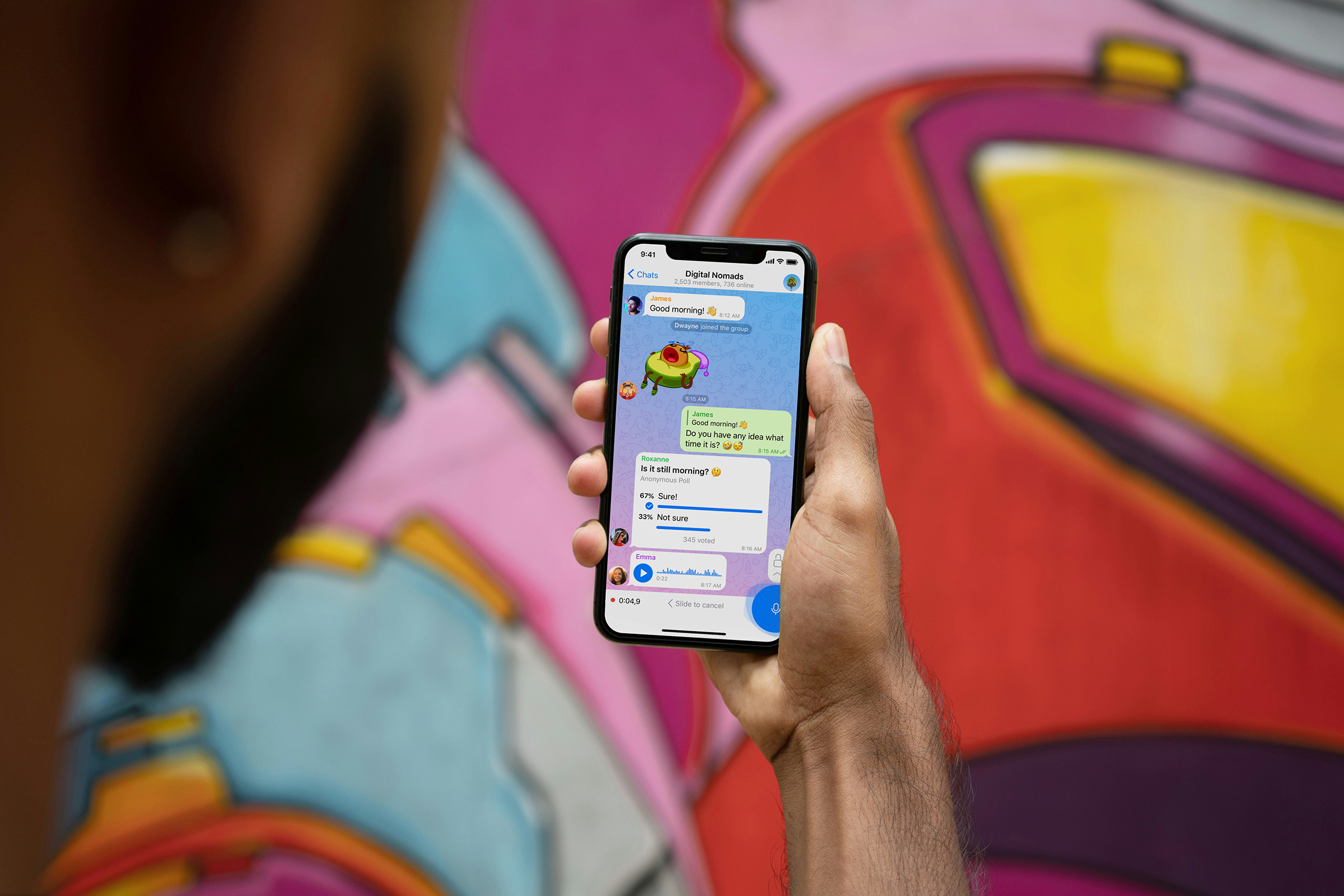
A man lookig at his Telegram chat conversation

Image Credits

Telegram app screenshot: Telegram Messenger Press
Man looking at his phone: Photo by abillion on Unsplash

Overview

Telegram is one of the world’s largest messaging platforms, known for its speed, privacy features, and support for massive public channels and groups. With over 1 billion monthly active users and 450 million daily active users, it ranks among the top global social and communication apps

The platform has grown rapidly since its launch, from 35 million MAUs in 2014 to 1 billion by 2025, driven largely by its popularity in high‑volume communication markets. The Asia‑Pacific region represents Telegram’s largest user base, with India leading global downloads. Europe and Latin America follow, while the Middle East and North America account for a smaller but steadily growing share.

Telegram’s ecosystem includes millions of public channels, many of which serve as real‑time hubs for news, entertainment, and community updates. Some of the largest individual channels have tens of millions of subscribers. This scale, combined with Telegram’s open, high‑volume communication model, creates a unique challenge: users often receive more notifications than they can meaningfully process. This case study focuses on redesigning Telegram’s notification experience to help users stay informed without feeling overwhelmed.

Details

Client

Telegram Group Inc., Concept Project

Role

UX Designer (Research, Interaction Design, Wireframing, Prototyping, UI Design)

Tools

Figma, Google Workspace, Adobe Creative Suite, Copilot, Pen & Paper

Duration

Three‑week sprint

Methods

User Surveys, Competitive Analysis, User Flows, Wireframing, High‑Fidelity Design, Lightweight Usability Testing

Deliverables

User Flows, Wireframes, High‑Fidelity Screens, Interactive Prototype, Usability Findings, Case Study

Problem Definition

Telegram’s notification experience fails to distinguish between relevant and irrelevant content, leading users to mute groups and channels and unintentionally miss valuable messages. There is an opportunity to introduce more personalized, interest‑based notification controls that help users stay connected to what they care about without the burden of constant noise.

  • Users receive too many irrelevant notifications from Telegram groups/channels.
  • Users miss important messages because everything is treated with the same priority causing many to mute them entirely.
  • Telegram lacks a way for the user to surface groups/channels content based on personal interests or keywords.
  • Users want more control over what triggers a notification.

Problem Statement

Telegram users in high‑volume groups mute conversations to avoid constant noise, but this causes them to miss messages they actually care about. They need a way to reduce interruptions without losing important updates.

Competitive Analysis

Scope

The goal of this competitive analysis was to understand how other platforms address notification overload and what UX patterns could inform a more relevance‑driven experience for Telegram. I focused on products that offer advanced controls such as keyword alerts, topic‑based filtering, smart relevance systems, priority notifications, and digest‑style summaries.

To guide the analysis, I explored several core questions:

  • How do these platforms let users control notification relevance
  • How do they reduce noise without hiding important messages
  • How do they introduce keyword or topic‑based alerts
  • How do they visually present notification settings
  • How do they onboard users to advanced notification features
  • How do they balance simplicity with customization

Competitors

  • Slack
  • Discord
  • Reddit

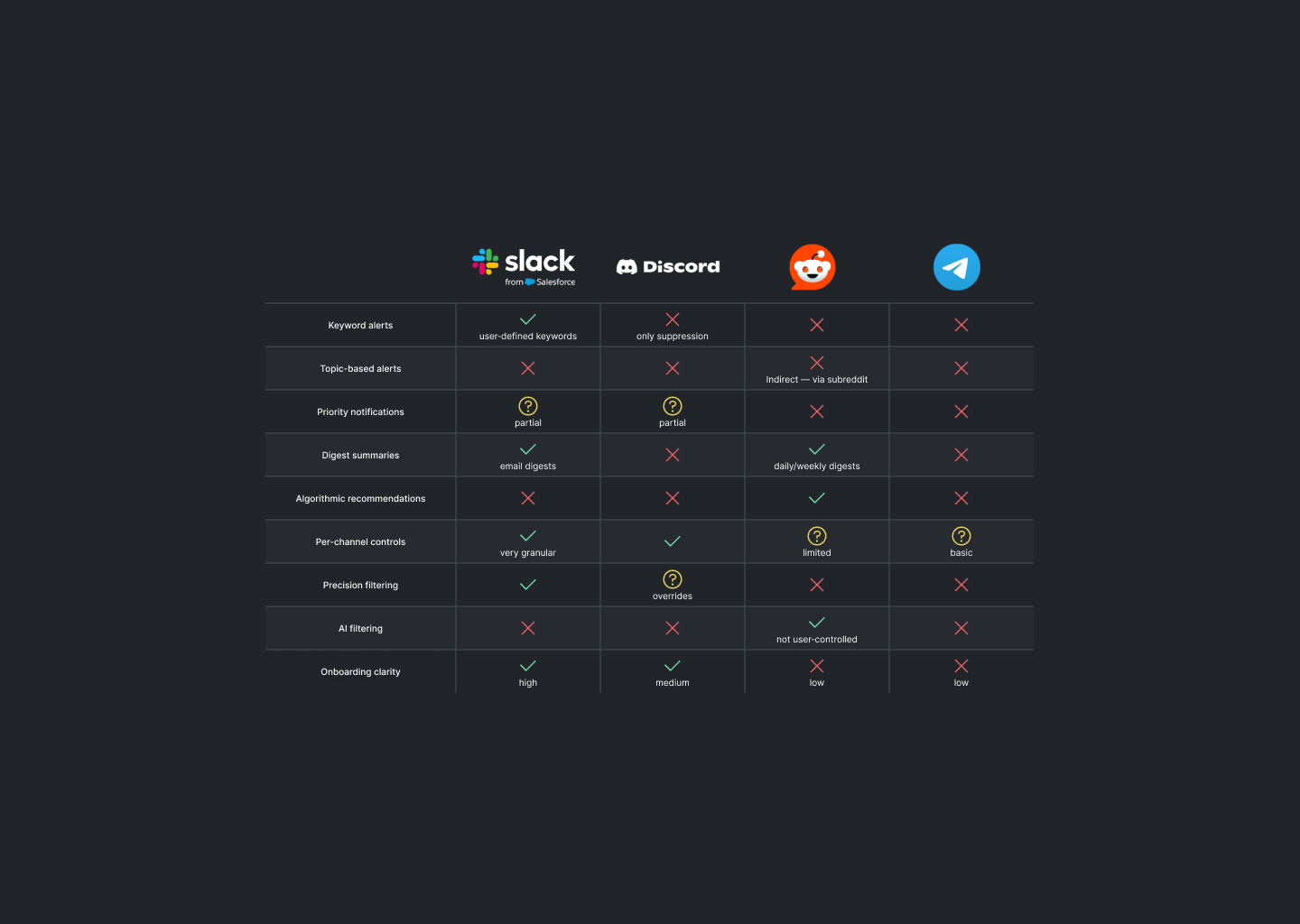
These platforms were selected because each tackles notification overload in a distinct way, from Slack’s precision keyword alerts, to Discord’s hierarchical channel controls, to Reddit’s algorithmic relevance and digest summaries. Together, they provide a strong foundation for identifying opportunities and best practices that can be adapted to Telegram’s ecosystem.

UX Teardowns

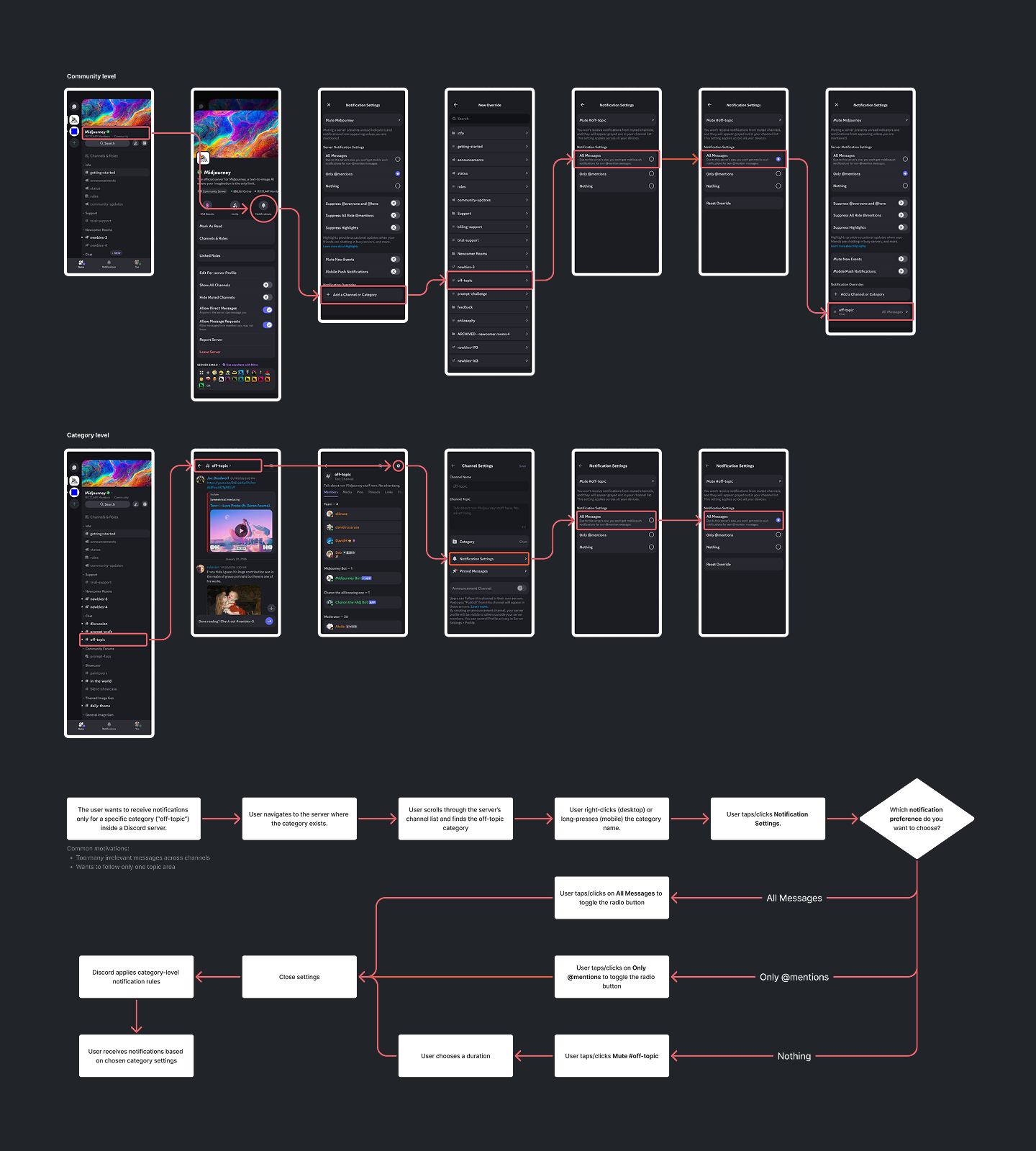
Discord

Notification Architecture

Discord provides a highly granular notification system designed for large, active communities. Key features include:

  • Server‑level notification settings (e.g., all messages, streaming alerts, voice activity, community activity, reaction notifications, status updates, trending alerts)
  • Channel‑level overrides
  • Role‑based mentions
  • Keyword suppression (filtering out terms rather than alerting on them)
  • Flexible mute durations ranging from 15 minutes to indefinitely
Strengths
  • The Server → Channel → Thread hierarchy is intuitive and scales well for large communities.
  • Granular overrides let users mute an entire server while keeping specific channels or categories active.
  • Role mentions provide targeted relevance without relying on keyword alerts.
  • Adjustable mute durations help reduce long‑term notification fatigue.
  • Strong visual clarity, toggles, icons, and labels are consistent and easy to scan.
Weaknesses
  • No true keyword alerts, only suppression.
  • Notification settings are distributed across multiple menus (server, channel, user), increasing cognitive load.
  • The system has a steep learning curve for casual or new users.
Patterns Telegram Can Borrow
  • Per‑channel overrides to give users more granular control.
  • Role‑based or category‑based logic to surface relevant messages without overwhelming users.
  • A clear visual hierarchy for notification settings to reduce friction and improve discoverability.
Competitors analysis - Discord

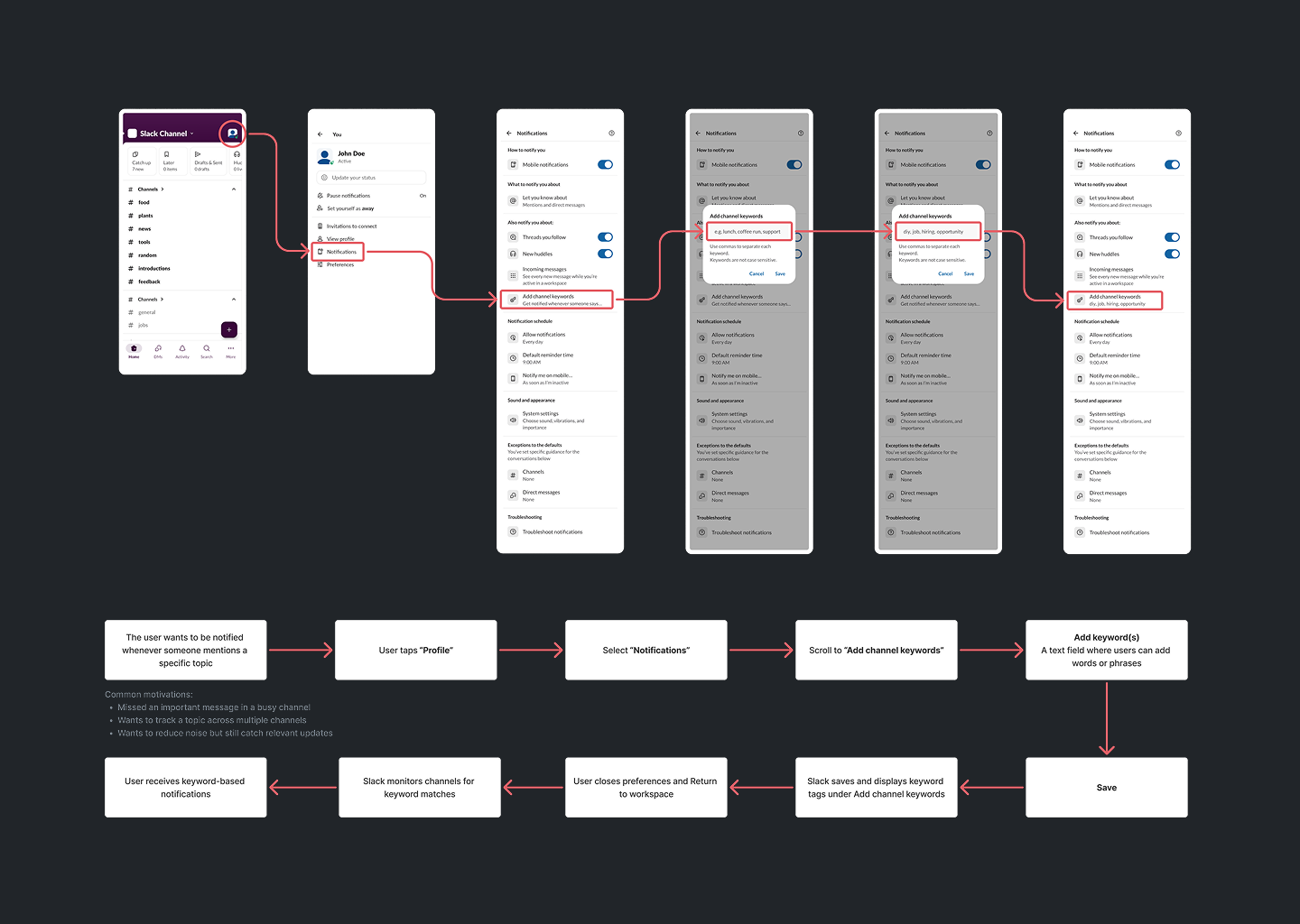
Slack

Notification Architecture

Slack has one of the most granular notification systems in mainstream apps:

  • Per‑workspace notification settings
  • Per‑channel overrides
  • Per‑thread notifications
  • Keyword alerts
  • Do Not Disturb schedules
  • Mobile push vs. desktop notifications
Strengths
  • Keyword Alerts: Users can define words/phrases that trigger notifications.
  • Per‑Channel Control: Users can mute channels, receive only mentions, or get all messages.
  • Thread‑Level Precision: Users can follow or unfollow specific threads.
  • Clear Hierarchy: Settings are logically grouped and easy to scan.
  • Strong Microcopy: Slack explains what each setting does in simple language.
Weaknesses
  • Overwhelming for new users, too many options.
  • Keyword alerts are hidden deep in preferences.
  • No topic‑based or AI‑based filtering, everything is manual.
Patterns Telegram Can Borrow
  • Keyword alerts
  • Per‑group notification overrides
  • Clear microcopy explaining notification behavior
Competitors analysis - Slack

Reddit

Notification Architecture

Reddit has effectively removed (or deeply buried) the old “Follow Topic” feature. Reddit’s notification system is built around:

Subreddit Membership
  • Subreddits they join
  • Subreddits they frequently visit
  • Subreddits Reddit recommends
User Activity
  • Replies
  • Mentions
  • Upvotes
  • Messages
  • Mod actions
Algorithmic Recommendations
  • Trending posts
  • Popular posts in related subreddits
  • “Because you viewed X” suggestions
General Notification Categories
  • Trending posts
  • Recommendations
  • Community updates
  • Chat messages
  • Mod mail
  • Follower activity
Strengths
  • Simple Notification Settings
  • Algorithmic Surfacing of Interests
Weaknesses
  • No Topic‑Based Notifications: users can’t follow broad topics.
  • Lack of precision: users can’t define keywords.
  • Algorithmic Recommendations Lack Transparency: users don’t know why they’re seeing certain alerts.
  • Limited per‑subreddit control: users cannot define what “important” means.
  • No Digest Customization
Patterns Telegram Can Borrow
  • Digest notifications
  • Behavior‑based relevance scoring
Competitors by feature table

Key Findings From User Survey

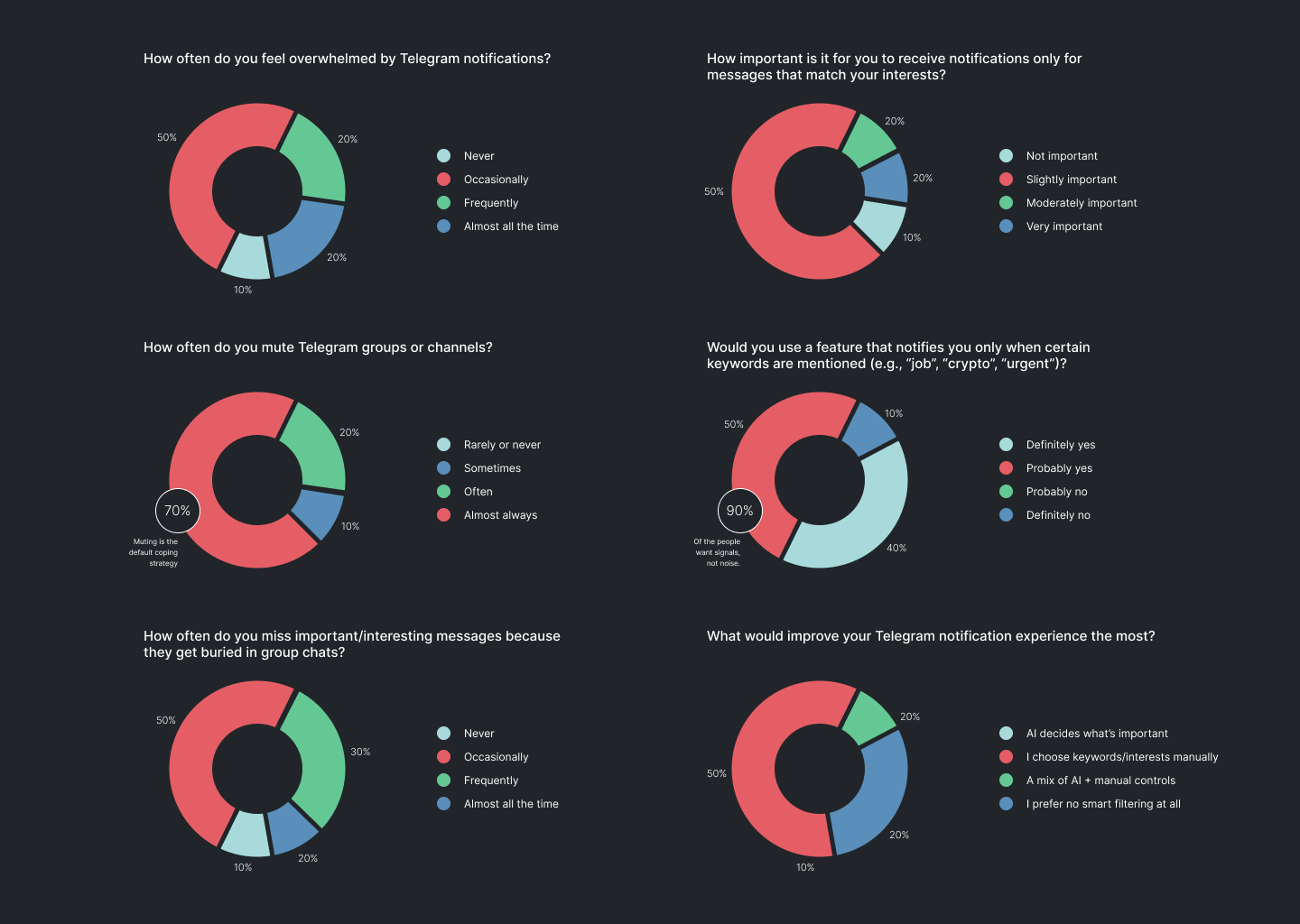
I collected ten early survey responses from Telegram users who participate in groups and channels. While the sample size is small, clear patterns emerged. Most participants mute groups “almost always,” yet still report missing important messages, suggesting that Telegram’s current controls reduce noise but fail to surface relevance. Interest‑based and keyword‑based notifications received strong support, while trust in fully automated AI filtering was low. Participants preferred either manual keyword control or a hybrid model where AI assists but users remain in control. These findings highlight a clear opportunity for Telegram to introduce relevance‑driven notification features that balance noise reduction with user control.

Key Insights

1. Muting is the default coping strategy

Most participants mute groups “almost always,” regardless of satisfaction level. This suggests Telegram’s controls are insufficient for managing noise.

2. Users miss important messages despite muting

Even users who mute everything still report missing important content. This highlights a gap between noise reduction and relevance.

3. Users want relevance, not more settings

Interest‑based and keyword‑based notifications received strong support. People want signals, not noise.

4. AI trust is mixed, but hybrid models are appealing

Participants prefer:

  • Manual keyword control
  • Or a mix of AI + manual
  • Almost no one wants fully automated AI filtering

This suggests a “human‑in‑the‑loop” design direction.

5. A surprising number think the system is “fine”, but still mute everything

This is classic: “I’m used to it, but it doesn’t work well.” This is a latent need, not an absence of need.

Opportunity Areas

1. Keyword‑based notifications

Strong interest, low risk, high clarity.

2. Topic‑based relevance

Moderate interest, but could be powerful if optional.

3. Hybrid smart notifications

AI assists, but users stay in control.

4. Highlighting relevant messages

High interest and low complexity.

5. Per‑group notification rules

Useful for power users.

A few charts from user survey results

Heuristic Evaluation of Telegram’s Notification System

To understand why Telegram users frequently mute groups and miss important messages, I conducted a heuristic evaluation using Nielsen’s 10 Usability Heuristics. This analysis revealed systemic issues in how Telegram communicates, structures, and prioritizes notifications, and it highlighted clear opportunities for improvement.

1. Visibility of System Status

Telegram provides only basic feedback about notification behavior. Users can mute or unmute chats, but the system never explains what they will be notified about or why a notification was triggered. Large groups offer no indication of expected message volume, leaving users unprepared for the noise.

Opportunity: Introduce clearer explanations of notification behavior, volume indicators for large groups, and contextual “You were notified because…” messaging.

2. Match Between System and the Real World

Users think in terms of topics, interests, and importance, but Telegram’s notification model is limited to chats and mentions. This mismatch forces users to manually sift through multi‑topic conversations without tools that reflect their mental models.

Opportunity: Support interest‑based or topic‑based notifications that align with how users naturally categorize information.

3. User Control and Freedom

Telegram offers limited control beyond mute/unmute. There are no granular overrides, and no way to undo accidental changes. Users often mute entire groups as a coping mechanism, losing access to important updates.

Opportunity: Add keyword or topic rules, and undo options to give users more nuanced control.

4. Consistency and Standards

Notification settings behave differently across private chats, groups, and channels, with little explanation. Controls are scattered across menus, and similar actions sometimes produce different outcomes.

Opportunity: Create a unified, consistent notification model across all chat types.

5. Error Prevention

Telegram does not warn users when enabling notifications in high‑volume groups, nor does it guide them toward smarter alternatives. Users often overwhelm themselves unintentionally.

Opportunity: Provide proactive guidance such as “This group is high‑volume, enable smart notifications instead?”

6. Recognition Rather Than Recall

There is a central overview of muted chats. But users must remember why they muted them, and what notifications they expect.

Opportunity: Improving the Groups/Channels Notification Overview screen summarizing active rules, muted chats, and custom settings.

7. Flexibility and Efficiency of Use

Telegram lacks advanced tools for power users. There are no keyword alerts, no filtering options, and no automation. High‑volume users have no efficient way to surface relevant content.

Opportunity: Add advanced features such as keyword alerts, topic filters, and smart summaries.

8. Aesthetic and Minimalist Design

While Telegram’s interface is clean, its minimalism hides important notification controls. Many settings lack context or explanation, making them difficult to understand.

Opportunity: Use progressive disclosure and microcopy to clarify settings without cluttering the UI.

9. Help Users Recognize, Diagnose, and Recover from Errors

Telegram provides no explanations for missed notifications or unexpected alerts. Users cannot diagnose why something happened or how to fix it.

Opportunity: Add contextual explanations such as “You missed this message because the chat was muted.”

10. Help and Documentation

Telegram offers no in‑app guidance for notification settings. There are no tooltips, onboarding flows, or help pages explaining how notifications work across different chat types.

Opportunity: Introduce lightweight onboarding and contextual help to improve understanding and reduce confusion.

Summary

Across Nielsen’s heuristics, Telegram’s notification system shows consistent gaps in clarity, control, and relevance. These issues directly contribute to notification fatigue and explain why users mute entire groups, even when they risk missing important messages.

This evaluation highlights a clear opportunity: Telegram needs a smarter, more transparent, and more user‑centered notification model that supports relevance without overwhelming users.
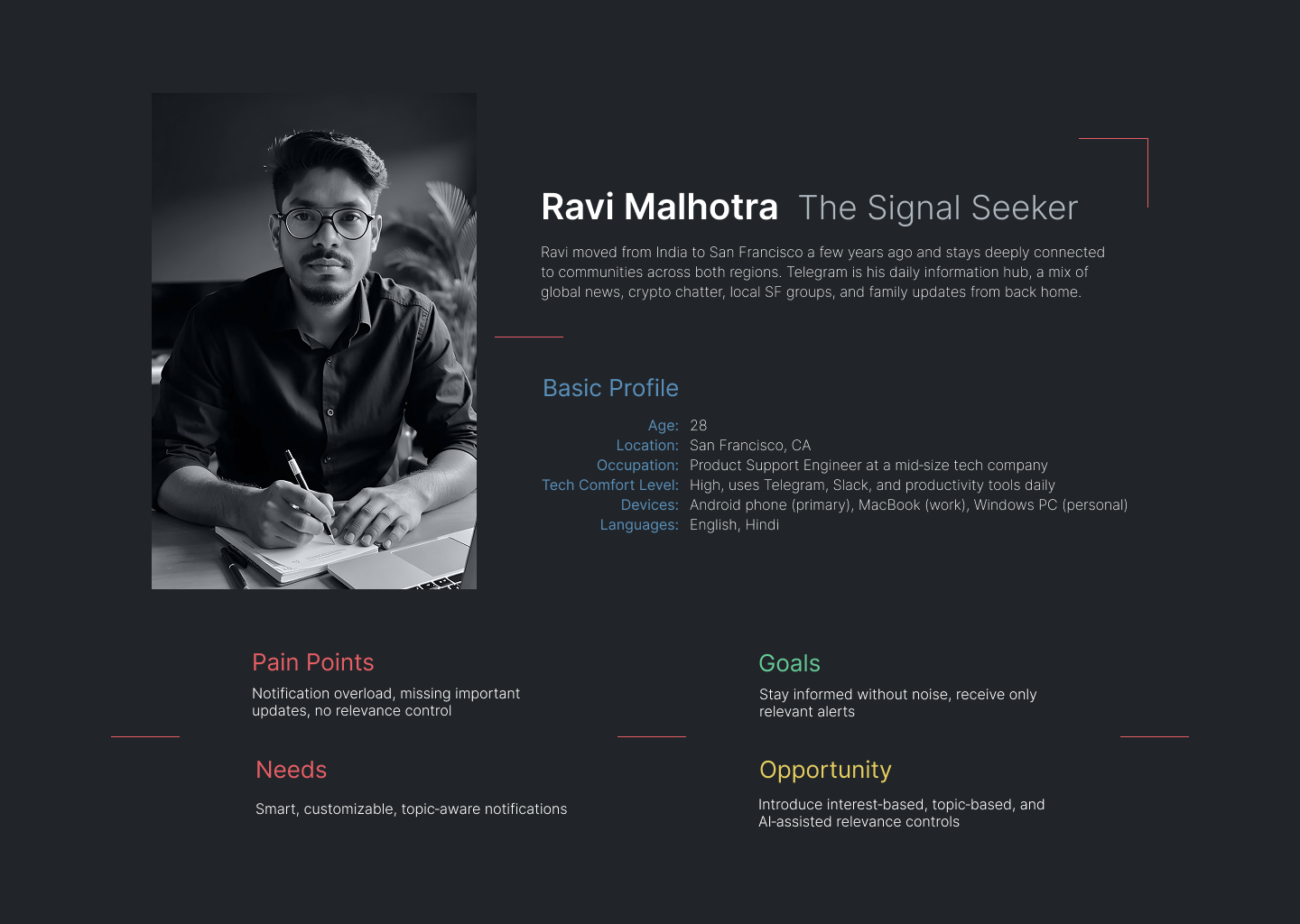
User Persona: Ravi Malhotra

Profile

  • Age: 28
  • Location: San Francisco, CA
  • Occupation: Product Support Engineer
  • Tech Comfort: High
  • Devices: Android (primary), Windows PC
  • Languages: English, Hindi

Background

Ravi moved from India to San Francisco and stays connected to communities across both regions. Telegram is his daily information hub, from global news and crypto updates to local SF groups and family chats. It’s where he keeps up with everything, but also where he feels the most overwhelmed.

Current Behavior

  • Checks Telegram 20–30 times/day
  • Has muted most groups and channels
  • Scrolls manually to find relevant messages
  • Uses folders but still misses important updates
  • Relies on keyword search when catching up

Pain Points

  • Notification Overload: High‑volume groups drown him in noise.
  • Fear of Missing Out: Muting helps focus but causes him to miss rides, jobs, and family updates.
  • No Relevance Control: Only mute/unmute; no filtering.
  • Manual Filtering Fatigue: Scrolls through hundreds of messages.
  • AI Skepticism: Open to AI, but wants transparency and override control.

Goals

  • Stay informed about specific topics (crypto, biking rides, jobs, emergencies)
  • Avoid constant interruptions
  • Catch up quickly
  • Maintain control over what triggers notifications
  • Reduce time spent scrolling

Needs

A smarter notification system that:

  • Filters by keywords or topics
  • Highlights relevant messages
  • Bundles updates into digests
  • Supports per‑group overrides
  • Balances AI assistance with manual control
User Persona: Ravi Malhotra — The Signal Seeker
User Persona: Ravi Malhotra — “The Signal Seeker”

Design Principles

Familiarity

New features follow Telegram’s existing patterns and live within the same settings screens, ensuring a seamless experience with no learning curve.

Clarity

Every control is simple, readable, and immediately understandable, users always know what a setting will do.

User Control

People can fine‑tune relevance, topics, and keywords globally or per group, with transparent overrides.

Lightweight Experience

The interface stays minimal and unobtrusive, reducing cognitive load while fitting naturally into Telegram’s visual language.

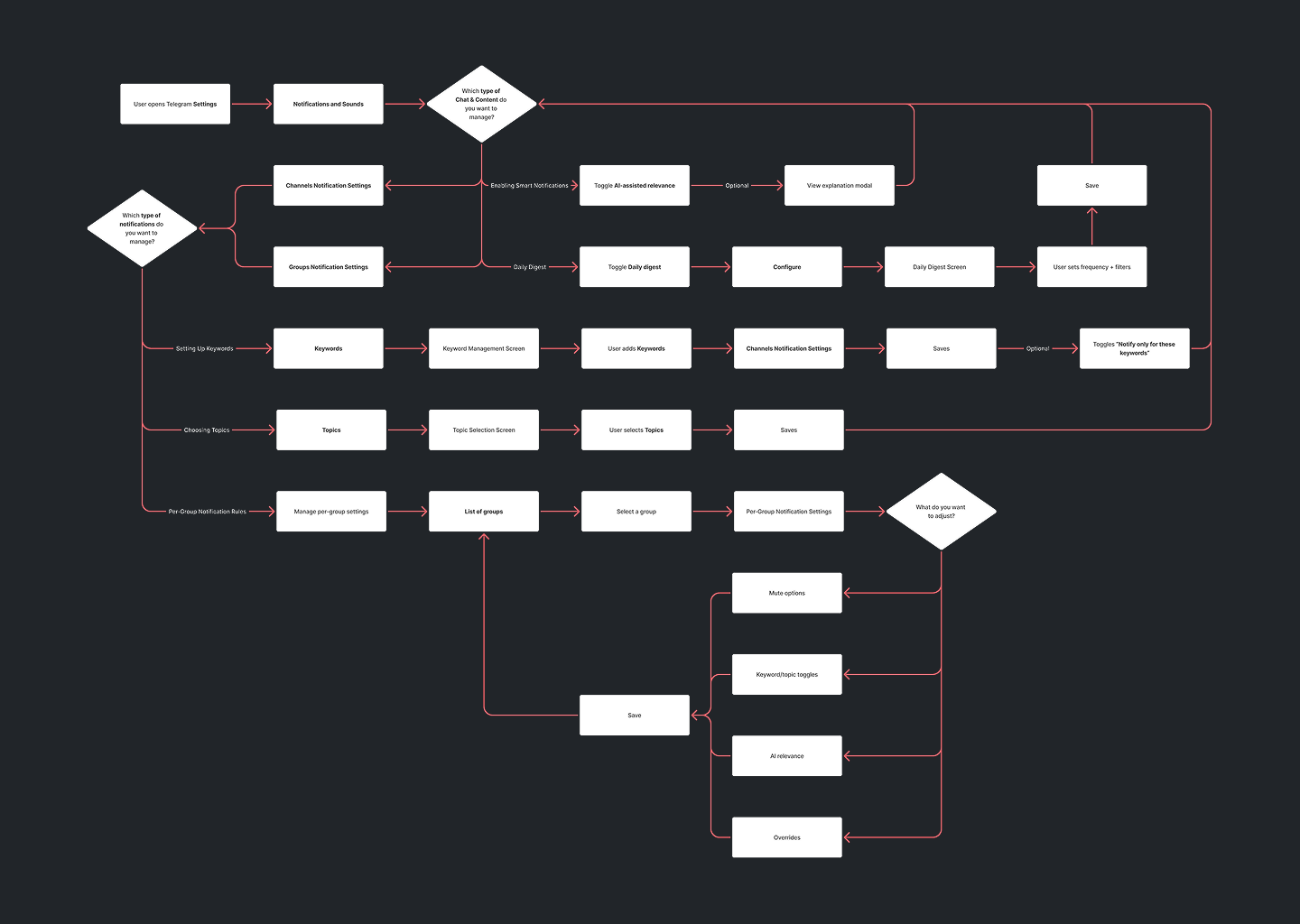
User Flow

The redesigned notification system fits naturally into Telegram’s existing settings screens, minimizing friction while introducing smarter, relevance‑based controls. Users can manage global preferences, fine‑tune per‑group or per‑channel settings, and configure AI‑assisted features, all without learning new patterns.

Flow Highlights

  • All features are embedded within Telegram’s existing UI patterns
  • Users can manage relevance at both global and group/channel levels
  • Confirmation messages and toggles follow Telegram’s native interaction style
User flow for a redesigned notification system”

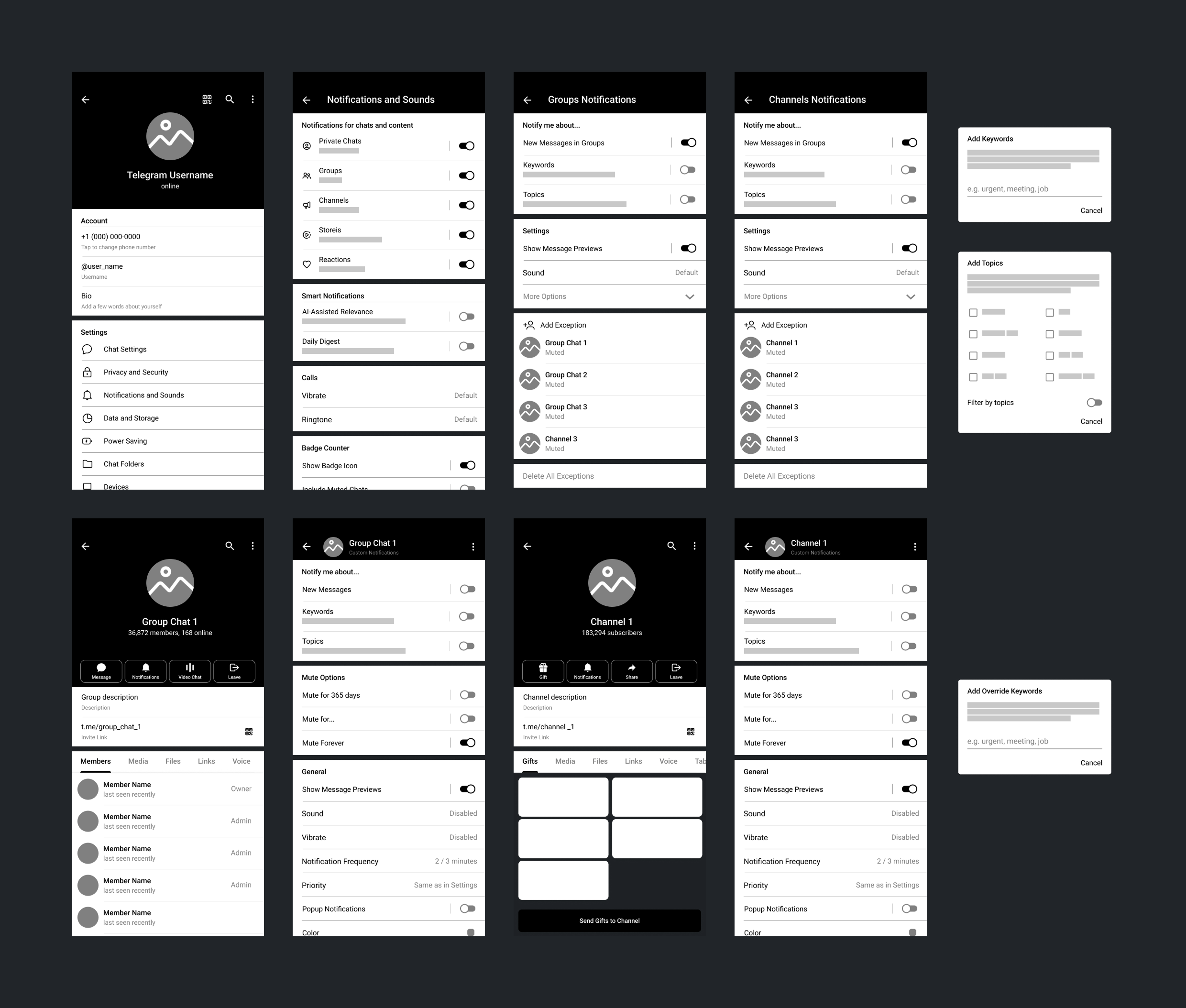
Wireframes

The wireframes explore how the redesigned notification system fits into Telegram’s existing settings structure while introducing new relevance‑based controls. Each screen builds on familiar patterns to minimize cognitive load and ensure current users can navigate the new features without friction.

Mid fidelity wireframes
Mid fidelity wireframes”

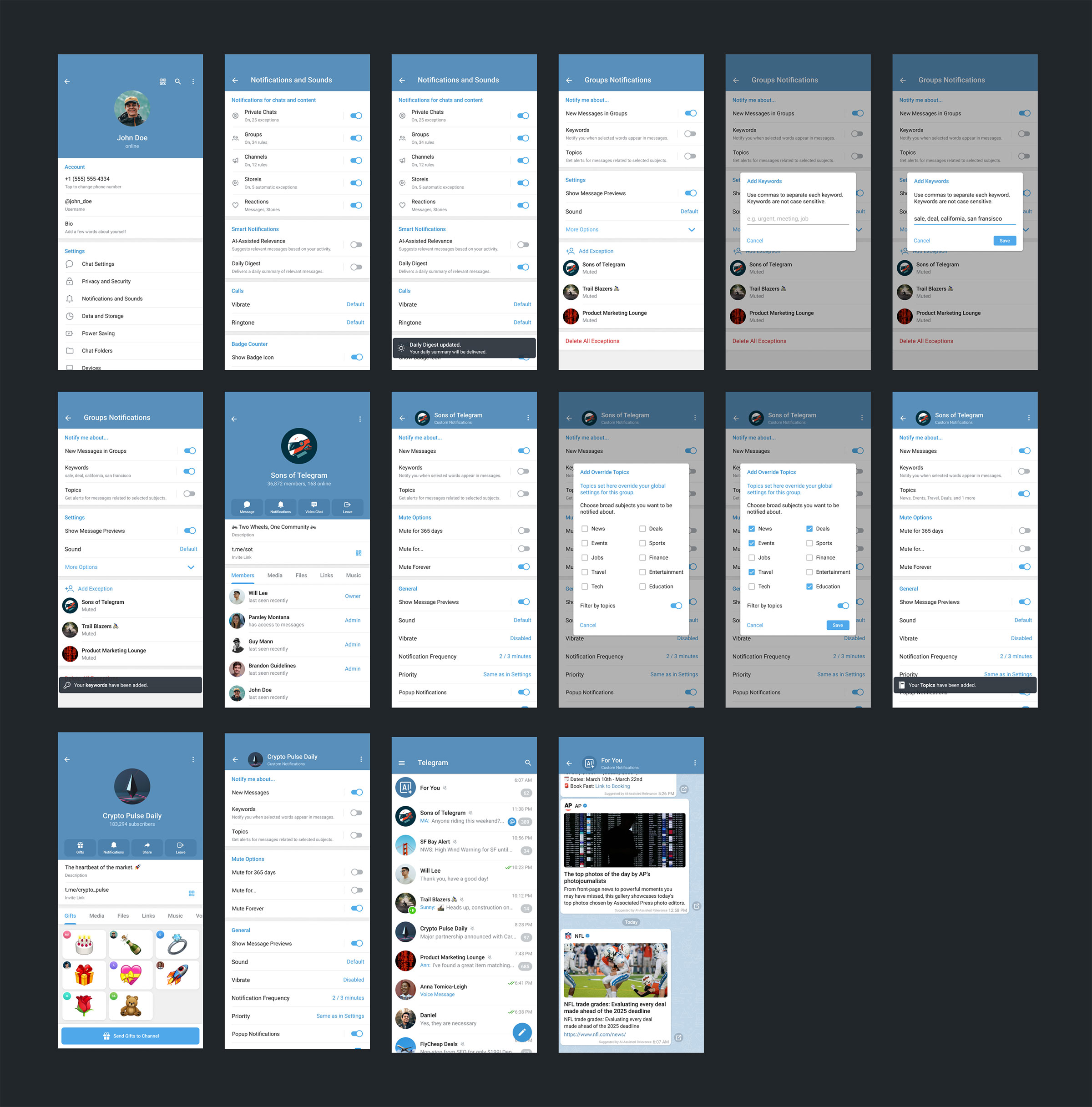
High‑Fidelity Designs

The high‑fidelity designs bring the relevance‑based notification system into Telegram’s existing interface with minimal disruption. The final UI focuses on clarity, lightweight interactions, and user control. AI‑Assisted Relevance, Topics, Keywords, Daily Digest, and per‑group overrides are all integrated into the same settings screens Telegram already uses, reducing cognitive load and maintaining a seamless, familiar experience.

The prototype explores four key flows that demonstrate how the new features fit naturally into Telegram’s notification ecosystem.

1. Global Notification Settings

This flow shows how users can set general notification rules directly from Telegram’s main settings. From here, they can enable AI‑Assisted Relevance, configure Daily Digest, and adjust overrides for individual chats, groups, and channels — all within the existing “Notifications and Sounds” hierarchy.

2. Group Notification Settings

Within a group’s notification settings, users can fine‑tune relevance by adding keywords, selecting topics, and adjusting mute behavior. They can also modify notification sound, frequency, and appearance. The layout mirrors Telegram’s current structure, making advanced controls feel intuitive and predictable.

3. Channel Notification Settings

Channel settings follow the same pattern as groups, allowing users to set keyword and topic filters, adjust mute options, and customize notification behavior. This consistency reinforces learnability and ensures users don’t need to relearn patterns across different chat types.

4. AI‑Assisted Relevance Feed

This flow illustrates how AI‑Assisted Relevance surfaces important messages across public groups and channels. Relevant content appears as a dedicated conversation at the top of the chat list, giving users a quick, consolidated view of what matters without requiring them to scroll through multiple high‑volume chats.

High fidelity prototype
High fidelity prototype”

Usability Testing

Lightweight Validation

To validate the clarity and usability of the redesigned notification settings, I conducted a quick usability check with three Telegram users. The goal was to confirm whether the new relevance‑based controls felt intuitive and whether users could complete key tasks without guidance.

Key Findings

  • All participants understood the purpose of AI‑Assisted Relevance and Daily Digest.
  • Keyword and Topic selection UI felt familiar and aligned with Telegram’s existing patterns.
  • Two participants were unsure about the difference between Topics and Keywords, suggesting that clearer captions or brief in‑app explanations could improve comprehension.
  • One participant wasn’t sure whether the Daily Digest would arrive as an email, push notification, or in‑app summary, indicating the need for clearer labeling or onboarding.
  • All participants appreciated that the new features were integrated into existing screens rather than introduced as separate flows.

Reflection

This project gave me the opportunity to rethink how a high‑volume messaging platform can support users who want to stay informed without feeling overwhelmed. Designing within Telegram’s existing structure taught me how to introduce new functionality without disrupting established mental models. Every decision required balancing innovation with familiarity, ensuring that relevance‑based controls felt native, predictable, and lightweight.

Working on notifications also deepened my understanding of attention management. Users want help filtering noise, but they also want transparency and control. Finding the right balance between automation and user agency shaped many of the interaction patterns in this redesign.

Conducting research and usability testing, even at a small scale — surfaced insights I wouldn’t have uncovered on my own. It highlighted the importance of clear labeling, especially around new concepts like Topics, Keywords, and Daily Digest. It also reminded me how challenging participant recruitment can be. Coordinating schedules, finding the right user types, and encouraging participation required persistence and flexibility, reinforcing the need to plan recruitment early in the process.

Overall, this project strengthened my systems‑thinking approach and sharpened my ability to design within constraints. It also reaffirmed the value of iterative validation, even when resources are limited. With more time, I would explore onboarding patterns to help users understand new features and conduct broader testing to validate how these controls scale across different user groups.